
Publication: Business Day
Author: Ravi Naidoo
Photo: YES Supplied
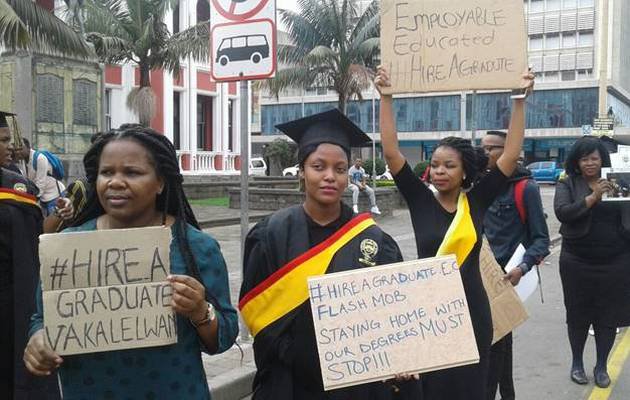
South Africa is spending its way into a youth employment crisis. The country allocates R500 billion a year to education and skills development – one of the highest proportions of GDP among emerging economies – and yet 61% of South Africans aged 15–24 are currently unemployed.
More than 4.7 million young people between 15 and 34 are looking for work and finding none. Another 10.6 million have stepped out of the labour market altogether. And 76% of unemployed youth have been without work for more than a year.
The proximate cause is growth, or rather, the lack thereof. The economy needs consistent growth of over 3% to generate net jobs, rather than the paltry annual average of 1.1% achieved from 2009–2026. Once population growth of 1.3% is factored in, GDP per capita has been declining for 17 years.
Despite the massive R500 billion a year annual budget, little of it seems to have made young people more employable. The system’s key performance indicator is production of certificates rather than employability. Only the fortunate few who enter universities are finding jobs, and even there the formal employment rates are under pressure as artificial intelligence starts to impact entry-level roles across auditing, financial services, logistics and administration.
Meanwhile, the automotive sector – one of South Africa’s most important manufacturing employers – faces structural disruption as Chinese vehicle brands capture market share at speed, with implications for every plant, supplier, and logistics operator in the value chain.
It is easy to look at this situation and despair. Instead, we need a national response to what is, in effect, a national jobs emergency.
The first and most urgent priority is to reorient education and training around employment outcomes rather than certification. Basic education must see matriculants graduate with some foundational employability skills, including the ability to start a business. Currently 90% complete their matric with insufficient mathematics, stunting the career options of young people and starving the economy of technical skills.
Post-school education is in an equally dismal state. Fewer than 20% students in technical and vocational colleges are studying trades the economy actually needs. The rest are completing courses with little market value. We do not need to spend more – we need to spend differently, with every qualification tied to a guaranteed employment pathway, co-funded by government and the private sector. If R25 billion – just 5% of the R500 billion annual budget – were redirected to a jobs guarantee scheme, 600,000 apprenticeships could be co-funded annually.
Those apprentices need somewhere to build their skills. Network infrastructure – fibre networks, transmission grids, railways, ports, green energy installations – is precisely the domain where both technical skills and significant labour are needed, and where public investment directly creates employment. Targeted sector development in tourism, digital services and green industries can add further opportunities. None of these alone will fully close the gap, but together, with the right incentives, they can generate employment at a scale that goodwill cannot.
The second priority is to make it substantially easier for companies to hire young people. Labour regulation that applies uniformly to all workers may be appropriate for those with established livelihoods to protect. For a first-time worker under 25, the same framework is a deterrent – it discourages employers from taking a chance on someone without a track record.
The third priority is to scale what is already working. Think of the national jobs response as a computer: it needs many components – public employment programmes, infrastructure investment, education reform, regulatory change. YES is designed to be the enabling component inside that machine – the part that takes young people from disadvantaged backgrounds, places them inside real companies for a genuine year of work, and lets the results speak.
And the results do speak for themselves. With over 2,000 sponsoring companies and 225,000 youth alumni, it has become the biggest private sector funded youth jobs programme in the world. The know-how and intellectual property that young people gain through their workplace experiences in the many leading companies is a national asset – one that compounds over time as alumni move into permanent roles, start businesses and mentor the next cohort.
But the programme is being artificially constrained. Currently, 40% of South African companies are blocked from participating because the B-BBEE codes require them to satisfy other elements – black ownership, skills spend – before they are permitted to sponsor YES youth jobs. This is a peculiar ordering of priorities for a country that routinely describes youth employment as its biggest challenge.
Finally, if youth employment is our top priority – as President Cyril Ramaphosa has repeatedly stated – then every relevant law, regulation and administrative measure must be reviewed and aligned to that goal. Youth employment cannot be the last box companies are permitted to tick. It must be the first.
This year marks 50 years since the Soweto uprising. Those students decided the inherited system was unacceptable and acted accordingly. The system South Africa’s youth have inherited today – one that takes their taxes, issues them certificates and then cannot find them work – is equally unacceptable. We need now to address this challenge with the same urgency and focus.
ends


 Amendment to the Gazette