
Publication: News24
Author: Opinions editor, Vanessa Banton
Photo: PeopleImages/Getty Images
There is a structural disconnect between what the education and training system produces and what employers need, writes the author. PeopleImages/Getty Images
South Africa’s youth unemployment crisis won’t be solved by more training programmes alone – but by redesigning the entire system to connect young talent directly to the growth sectors that will define the country’s economic future, writes Ravi Naidoo.
When we consider our soaring youth unemployment figures, people often ask: Where will the millions of jobs come from?
The answer is that, ultimately, they come from a growing economy. It is not about how much we spend on training or how many youth programmes we have.
But that’s not the end of the conversation. It’s where the more interesting question begins: how do we design youth employment programmes that actively help to grow the economy, rather than simply waiting for growth to arrive?
This is how we think of our work at YES – not as a youth jobs programme, but as a talent pipeline programme deliberately structured to support economic growth. Preparing young people for the world of work is the best endowment any country can make to achieve a sustainable future.
What skills are needed?
What skills will emerging sectors need? Where are the leapfrogging opportunities? How do we get young people into workplaces where they can develop technical competence as well as the entrepreneurial instincts and social networks that will make them job creators, not just job seekers?
But there’s another important point that tends to get lost: youth employment services would be necessary even in a fully employed economy. The jobs of the next decade will look very different to the jobs of today, and we need young people who are ready – and well-positioned – to work in and lead that economy.
Within this challenge, though, there is genuine reason for optimism. If we can equip more young people to work confidently with AI and digital tools – through microcredentials that are faster and cheaper than traditional training – South Africa has a real opportunity to benefit from the shifting patterns of global economic activity.
Government has broadly identified two sectors to prioritise: decarbonisation and digitisation.
On the green side, South Africa needs to scale rapidly for electric vehicles, renewables and battery technology – the Eastern Cape’s entire economic future is tied to how well we manage the transition away from internal combustion engines, for instance. This is precisely why YES is written into the South African Renewable Energy Master Plan as the designated talent pipeline for the sector.
On the digital side, South Africa is very well placed: our time zone spans the gap between Western and Eastern hemispheres, we speak English, and we have a strong financial services foundation. Global business services and IT present enormous opportunities, and AI literacy is fast becoming a baseline requirement not just in technology roles, but across logistics, manufacturing, banking and agriculture.
Structural disconnect
Beyond these, both smart agriculture and mining – which sits on critical minerals the world urgently needs – offer further substantial opportunity. Across all these sectors, what is missing is a sustained pipeline of people prepared to meet it.
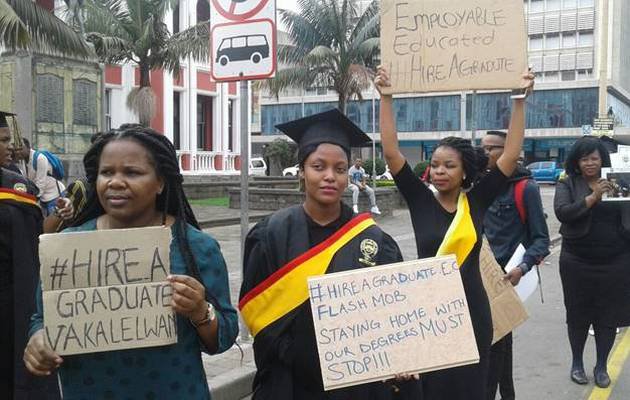
Paradoxically, South Africa spends more per capita on education than almost any country in the world, yet our outcomes sit near the bottom of international rankings. The reason is not a lack of investment; it’s a structural disconnect between what the education and training system produces and what employers need. Training, at present, produces certificates. What companies need is employability.
The consequences are visible at every level. More than 90% of TVET graduates struggle to find work, and the majority are not studying the trades the country most desperately needs – plumbers, electricians, water technicians. These are the very people who could fix the infrastructure constraints suppressing economic growth. Reconnecting the supply side of education with the demand side of the economy is foundational to any serious strategy for reducing unemployment.
The scale of the task demands clarity about what success requires. Approximately 800 000 to a million people enter the labour market each year, of whom somewhere between 300 000 and 400 000 find work. That means a structural backlog of around half a million people annually.
Two relatively straightforward policy shifts could address that backlog. The first is to place youth employment at the centre of the B-BBEE codes. After all, is it not repeatedly stated by politicians that youth unemployment is our most critical challenge? If that is so, then it should be reflected as such in our actual policy priorities.
Strengthening those incentives significantly – as countries like China and Brazil have done – could, for example, scale YES participation from 2 000 companies to 20 000, and annual placements from 40 000 to 400 000. Over a decade, that represents four million additional young people with formal sector work experience.
Pro-growth jobs
The second shift is to guarantee work for young people whose skills development taxpayers are already investing in. For example, redirect just 5% of the existing R500 billion annual education and training budget towards employment outcomes – using it to subsidise the first year of employment for any company that hires a TVET graduate in a priority trade. Done well, with one-to-one matching from the private sector, that 5% could generate a further four million jobs over 10 years.
That’s eight million additional youth jobs in total – and critically, every one of them pro-growth.
South Africa’s young people are not the problem to be solved – they are the most powerful resource we have to future-proof this country. What they need is not sympathy or short-term interventions, but interventions with an economic logic – the kind that unlocks talent pipelines, strengthens companies and future-facing sectors that will set our economy – and our youth – up for success. - Ravi Naidoo, CEO, Youth Employment Service (YES).
*Want to respond to the columnist? Send your letter or article to opinions@news24.com with your name and town or province. You are welcome to also send a profile picture. We encourage a diversity of voices and views in our readers’ submissions and reserve the right not to publish any and all submissions received.
Disclaimer: News24 encourages freedom of speech and the expression of diverse views. The views of columnists published on News24 are therefore their own and do not necessarily represent the views of News24.
*Want deeper context into what’s going on in the world? Read Friday Briefing every week to stay in the loop with opinion and analysis on current political, social, and economic issues affecting South Africa. Sign up to receive the Friday Briefing newsletter. Newsletter Weekly Opinions Weekly Opinions editor Vanessa Banton curates the best opinions and analysis of the week to give you a broader view on daily news happenings.


 Amendment to the Gazette